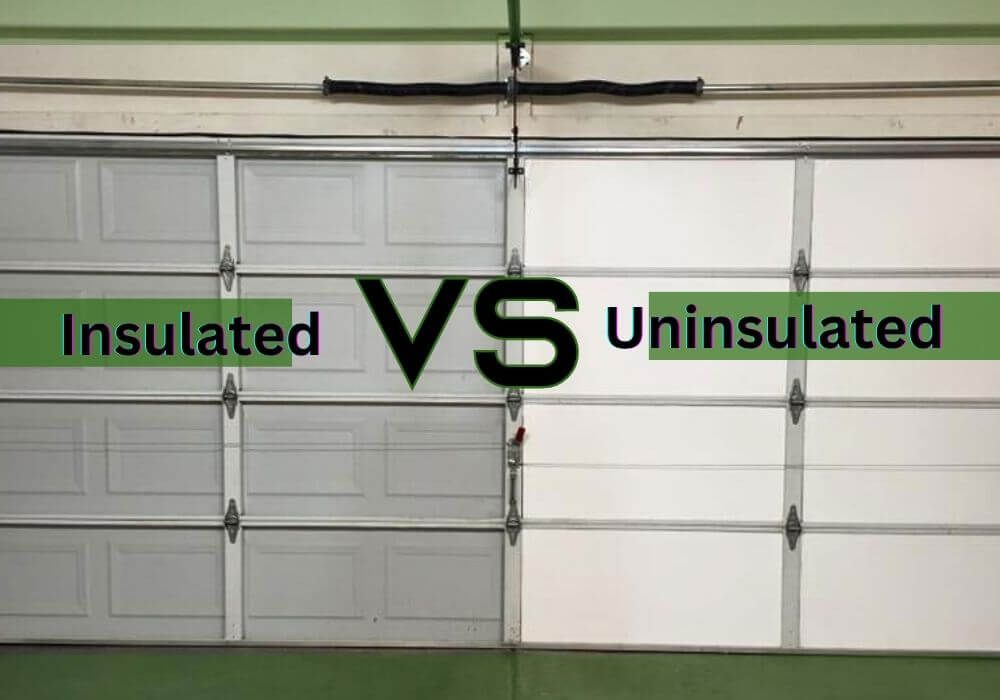
Insulated vs Non-Insulated Garage Doors
An insulated garage door has insulation inside the sections. A non-insulated, or uninsulated, door is usually a single layer of steel, aluminum, or wood with no insulating core. The difference is not only temperature. Insulation also changes stiffness, noise, dent resistance, door weight, and the hardware that has to lift it.
Neither type is automatically better. The right door depends on how the garage is used, whether it shares a wall with living space, and the condition of the opening, springs, and opener.
What Insulation Actually Changes
Most residential insulated doors use polystyrene or polyurethane between steel skins. Polyurethane is typically bonded to the skins and makes the section stiffer. Polystyrene is a rigid board placed inside the section. A non-insulated door has one skin and flexes more.
- Stiffness. An insulated section resists flexing. That matters on wider double-car doors, where a thin single-layer panel can oil-can or show waves.
- Noise. Two skins and a core reduce some street noise and the sound of the door itself. They do not soundproof a garage.
- Temperature. Insulation slows heat transfer through the door. It does not turn an unconditioned garage into a room. Walls, ceiling, windows, and the seal around the opening still matter.
- Weight. Insulated doors are heavier. The spring system and opener have to match that finished weight, not the weight of the old door.
Manufacturers publish an R-value for some models. A higher number means more resistance to heat flow through that section. Compare R-values only between similar constructions, and treat the number as one spec, not the whole decision. A high R-value does not fix a gap under the door or an uninsulated wall.
When an Insulated Door Helps
- The garage is a workshop, gym, or storage area you use often
- A bedroom, office, or living room shares a wall or sits above the garage
- Street noise, opener noise, or door rattle is a complaint
- The current single-layer sections dent, flex, or look wavy
- You want a steel door that holds its shape on a wide opening
In those cases, insulation is part of the door construction, not an add-on you can spray on later and call equivalent. Adding batt insulation to an existing single-layer door also adds weight the springs were not sized for. Do not hang material on the inside of a door without checking balance.
When a Non-Insulated Door Can Be Enough
A detached garage used only to park a car often does not need an insulated door. Construction quality, a sound bottom seal, and hardware that matches the door can matter more than the insulation rating.
A non-insulated door is lighter, which can make spring and opener selection simpler, and it usually costs less as a product. It is also easier to dent and can be noisier. If the quote is being chosen only on the lowest door price, ask what steel thickness, track, and spring system are included. A cheap section on worn hardware is not a savings.
Heat, Cold, and Coastal Moisture
South Bay summers and Santa Cruz County coastal weather do not change the basic comparison, but they change what else to look at.
- A dark, sun-facing door gets hot either way. Insulation reduces how fast that heat moves into the garage. It does not keep the outside skin cool.
- Near the coast, look at hardware, fasteners, and the bottom seal, not only the insulation core. Moisture shows up as rust at rollers, hinges, and the bottom of the section.
- Windows, decorative glass, and a worn perimeter seal can outweigh the door’s R-value. A well-sealed non-insulated door can feel tighter than an insulated door with daylight under it.
Springs and the Opener
This is the part most comparison articles skip. An insulated replacement is heavier than the single-layer door it replaces. The torsion springs have to be matched to the new door’s size and weight. Reusing springs that were sized for a lighter door leaves the opener lifting weight it should not carry.
The existing opener can stay if it is in good condition and rated for the new door. If it is already straining, missing safety sensors, or not rated for the added weight, opener work should be priced with the door, not discovered after installation. See garage door opener repair if the current unit is the problem, and spring repair if the door is heavy before you replace it.
What to Compare on a Quote
Ask for the same details on both an insulated and a non-insulated option:
- Section construction: single-layer, polystyrene, or polyurethane
- Steel thickness and whether the section is one skin or two
- Published R-value, if the manufacturer provides one
- Color, windows, and hardware included
- Track and a spring system sized for that door
- Whether the existing opener stays or is replaced
- Removal of the old door and any opening repairs
The garage door cost guide covers the other factors that move a price: size, windows, removal, and site conditions. We do not publish a blanket insulated-versus-uninsulated price because the door and the opening are not standard.
Repair the Door You Have, or Replace It
Insulation is a replacement decision, not a repair. A noisy, heavy, or reversing door usually needs the springs, rollers, tracks, cables, or opener checked first. Replacing a working door only to gain insulation makes sense when the sections are already failing, you want a different construction, or the garage is being used as more than parking.
If the bottom seal is the draft, start there. A flattened seal lets air and water in on both insulated and non-insulated doors. Related reading: how to weather-seal a garage door.
How WeDo Quotes a Replacement
We measure the opening, look at the existing springs and opener, and quote the door construction you actually want. South Bay calls go to Santa Clara at (408) 290-5673. Santa Cruz County calls go to Capitola at (831) 282-8312. Installation details are on the garage door installation page.